Finding reliable plastering companies in Dubai takes careful research. In the UAE, extreme summer heat and coastal humidity quickly test every wall finish. When crews rush surface preparation, walls soon develop cracks and hollow patches.
Therefore, property owners and project managers need clear knowledge before hiring a contractor. Whether you are building a villa or renovating an office, understanding plastering standards protects your budget.
This complete guide explains how wall plastering works in the UAE. First, you will compare building plaster, gypsum plaster, and decorative Venetian plaster in Dubai. Next, you will learn the exact cement-sand ratio for plastering and simple cement calculation for plastering. Finally, we explain why plaster mesh and plaster corner beads prevent costly wall cracks.
Quick Answer: Professional plastering companies in Dubai hold valid UAE trade licences and follow strict preparation rules. Specifically, crews apply dash coats, install mesh for plaster walls and plaster corner beads, and mix calibrated cement-sand ratios (1:4 to 1:6). Additionally, they water-cure cement walls for at least 7 days. For structural blockwork and smooth plastering in Dubai, you can also consult local teams like First Frame Contracting L.L.C.
What Is Wall Plastering, and Why Does It Matter for Dubai Buildings?
Wall plastering is the process of applying a smooth mortar coat over rough blocks or concrete. As a result, uneven structural walls become straight and ready for paint or tiles.
However, plastering in Dubai serves a much larger purpose than simple decoration. Because UAE buildings face extreme temperature swings, exterior and interior walls constantly expand and contract. Consequently, durable building plaster shields masonry from moisture, airborne salts, and thermal stress.
Moreover, quality plastering improves any building in four practical ways:
- Weather Protection:Cement plaster seals porous concrete blocks against humidity, rain, and dust.
- Sound Insulation: Dense mortar coats help reduce noise transfer between rooms and neighbouring units.
- Fire Safety: Fire-resistant cement and gypsum layers add extra fire protection to masonry walls.
- Surface Flatness: Level walls ensure that cabinets, skirting boards, and door frames fit without gaps.
Plastering Services in Dubai: What Plastering Companies Offer
Experienced plastering companies in Dubai handle both structural wall levelling and fine decorative finishes. Depending on your project stage, most companies offer six core services.
1. Internal Cement Wall and Ceiling Plastering
Crews apply base and finish coats of cement mortar over concrete blocks and concrete ceilings. Consequently, indoor rooms gain strong, impact-resistant surfaces suited for villas, warehouses, schools, and offices.
2. External Facade and Boundary Wall Rendering
Exterior walls face harsh sunlight, sandstorms, and seasonal humidity. Therefore, contractors apply thicker, weather-resistant cement render—often with waterproofing additives—to protect building facades and compound walls.
3. Gypsum Spray and Hand Plastering
Many modern towers in Dubai use gypsum plaster for dry internal walls. Because gypsum sets quickly and needs no water curing, it speeds up interior fit-out schedules.
4. Blockwork and Partition Plastering
During villa extensions or office upgrades, crews build new masonry partitions and finish them with smooth plaster. For example, contractors managing renovation and fit-out projects in JLT and Dubai regularly pair blockwork with precision plastering.
5. Plaster Repair, Damp Treatment, and Crack Fixing
Over time, water leaks or building settlement can cause plaster to bulge or crack. In these cases, technicians remove loose mortar, fix the moisture source, and replaster the area during routine building maintenance.
6. Decorative Wall Finishes and Venetian Plaster in Dubai
Beyond standard levelling, specialised artisans apply textured renders and luxury Venetian plaster in Dubai. These decorative finishes turn plain living room feature walls, hotel lobbies, and showrooms into polished focal points.
[Image Placeholder 1: Masons applying cement plaster with an aluminium straightedge on a block wall | Alt Text: plastering companies in Dubai applying smooth cement wall plaster]
Building Plaster vs. Gypsum Plaster vs. Venetian Plaster in Dubai
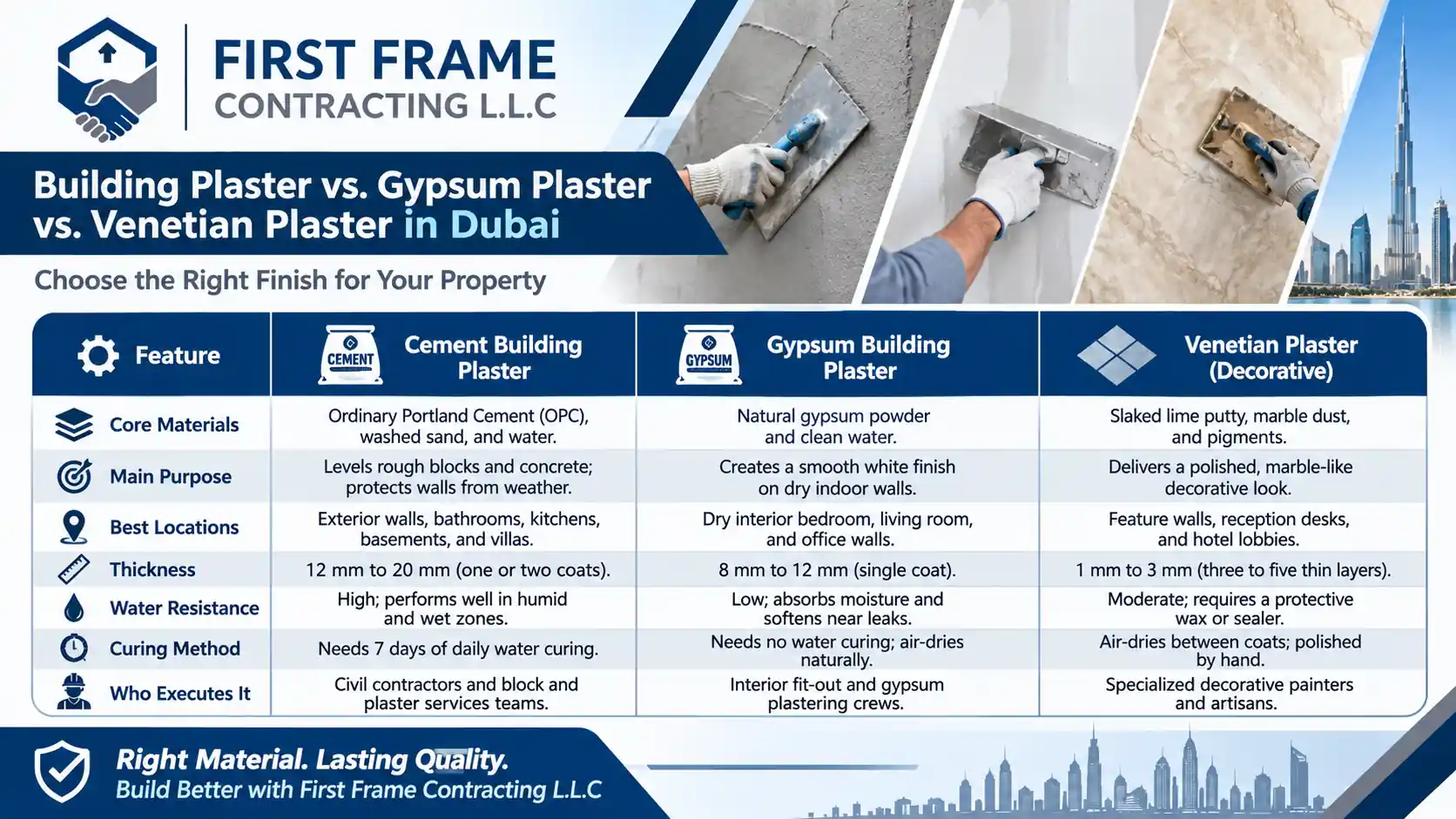
Building plaster is a functional cement or gypsum base coat used to level rough masonry walls. Conversely, Venetian plaster is a decorative lime-and-marble-dust finish applied in thin polished (smoothly rubbed) layers.
Many property owners confuse structural plastering with decorative plastering when requesting quotes. Therefore, comparing these three systems helps you pick the right material for each area.
Which Plaster Type Should You Choose for Your Dubai Project?
First, always choose cement building plaster for bathrooms, kitchens, balconies, and exterior walls where moisture occurs. Second, use gypsum plaster only in dry, air-conditioned rooms where fast handover matters. Finally, apply Venetian plaster only over a smooth, fully cured base wall for decorative appeal.
Plaster Mesh & Plaster Corner Beads: Why They Prevent Wall Cracks in Dubai
Plaster mesh and plaster corner beads stop cracks at material joints and protect sharp corners from chipping. Without these reinforcements, daily UAE heat swings cause concrete columns and masonry blocks to expand at different rates. Consequently, long cracks appear along wall joints within months.
Before applying mortar, experienced crews install three vital reinforcement accessories.
1. Mesh for Plaster Walls: Fibreglass vs. Galvanised Steel
Different building materials never expand or shrink at the exact same speed. Therefore, masons fix mesh for plaster walls across every joint where concrete columns meet concrete blocks. Additionally, crews install plaster mesh over all chased wall grooves cut for electrical wires and water pipes.
- Alkali-Resistant Fibreglass Mesh: Lightweight, flexible, and rust-proof. It embeds cleanly into cement or gypsum plaster to spread tension and prevent hairline cracks.
- Galvanised Steel Expanded Metal Lath: Heavy-duty metal mesh nailed over wide structural joints or thick plaster build-ups for extra grip.
2. Plaster Corner Beads (Angle Beads): Steel vs. PVC
External 90-degree wall corners, window reveals, and door frames suffer the most daily knocks. Without edge protection, a light bump from furniture or a trolley easily chips the plaster.
To prevent this damage, crews install a plaster corner bead along every exposed vertical and horizontal corner:
- Galvanised Steel Corner Beads: Best for dry interior rooms, offices, and hallways needing strong impact protection.
- Heavy-Duty PVC Corner Beads: Essential for bathrooms, kitchens, coastal homes, and exterior walls in Dubai. Because PVC never rusts, it stops brown rust stains from bleeding through exterior paint.
3. Stop Beads and Movement Joints
Where plaster ends against another material—such as window frames or skirting—crews install stop beads. As a result, the plaster edge stays crisp and straight. Similarly, on long boundary walls, builders place vertical movement joints every 4 to 5 metres to absorb thermal expansion.
[Image Placeholder 2: Close-up of galvanised plaster mesh and corner bead installed on a concrete-to-block joint | Alt Text: plaster mesh and plaster corner bead installed on wall joint]
Cement-Sand Ratio for Plastering: Standard Mix Ratios Used in the UAE
The standard cement-sand ratio for plastering ranges from 1:4 to 1:6 (one part cement to four to six parts washed sand). The exact ratio depends on the wall’s location and weather exposure.
Getting this mix right is essential for lasting wall strength. For example, too much cement makes plaster rigid and prone to shrinkage cracks. Conversely, too little cement leaves a weak, dusty surface that crumbles easily.
In UAE construction projects, engineers specify three standard ratios:
- Internal Walls (1:5 or 1:6): Delivers reliable strength and smooth workability for indoor block walls shielded from weather.
- Ceilings (1:3 or 1:4): Uses a richer cement mix applied thinner (10 mm to 12 mm) so mortar bonds firmly overhead.
- External Walls and Bathrooms (1:4): Resists harsh sun, humidity, rain, and heavy wall tile loads.
Washed Sand vs. Unwashed Sand: Why Sand Quality Matters as Much as the Ratio
Even a proper 1:4 mix fails if a contractor uses dirty sand. Specifically, unwashed desert or beach sand contains silt, clay, and natural salts. Over time, trapped salts rise to the surface as a white powder called efflorescence (white salt stains), which ruins paint. Therefore, always confirm that crews use clean, washed, salt-free plastering sand.
Cement Calculation for Plastering: Simple Step-by-Step Formula
To complete a cement calculation for plastering, multiply your wall area by the plaster thickness to find wet mortar volume. Next, add roughly 33% for dry-volume bulking and site wastage. Finally, divide that total by your cement-sand ratio.
Knowing this simple math helps you verify material estimates and spot quotes that cut back on cement.
Worked Example: Cement & Sand Needed for 100 m² of Wall Plaster
Suppose you want to plaster 100 square metres (m²) of internal wall at 15 mm (0.015 m) thickness using a 1:5 ratio:
- Find Wet Mortar Volume: Multiply wall area by plaster thickness in metres. 100 m² × 0.015 m = 1.50 m³ of wet mortar
- Convert to Dry Volume: Dry materials take up about 20% more space than wet mortar, plus sites average 13% wastage. Therefore, multiply wet volume by 1.33. 50 m³ × 1.33 = 2.00 m³ of dry material
- Calculate Cement Volume: Add your ratio parts (1 + 5 = 6 total parts). Cement equals 1 out of 6 parts. (1 ÷ 6) × 2.00 m³ = 0.333 m³ of cement
- Convert Cement to 50 kg Bags: One cubic metre of cement equals roughly 28.8 bags (at 50 kg each). 333 m³ × 28.8 bags = 9.6 bags (round up to 10 bags of 50 kg cement)
- Calculate Sand Volume:Sand equals the remaining 5 out of 6 parts. (5 ÷ 6) × 2.00 m³ = 1.67 m³ of washed plastering sand
Quick Reference Table: Cement & Sand per 100 m² (at 15 mm Thickness)
Use this reference table to check material quantities across standard UAE mix ratios:
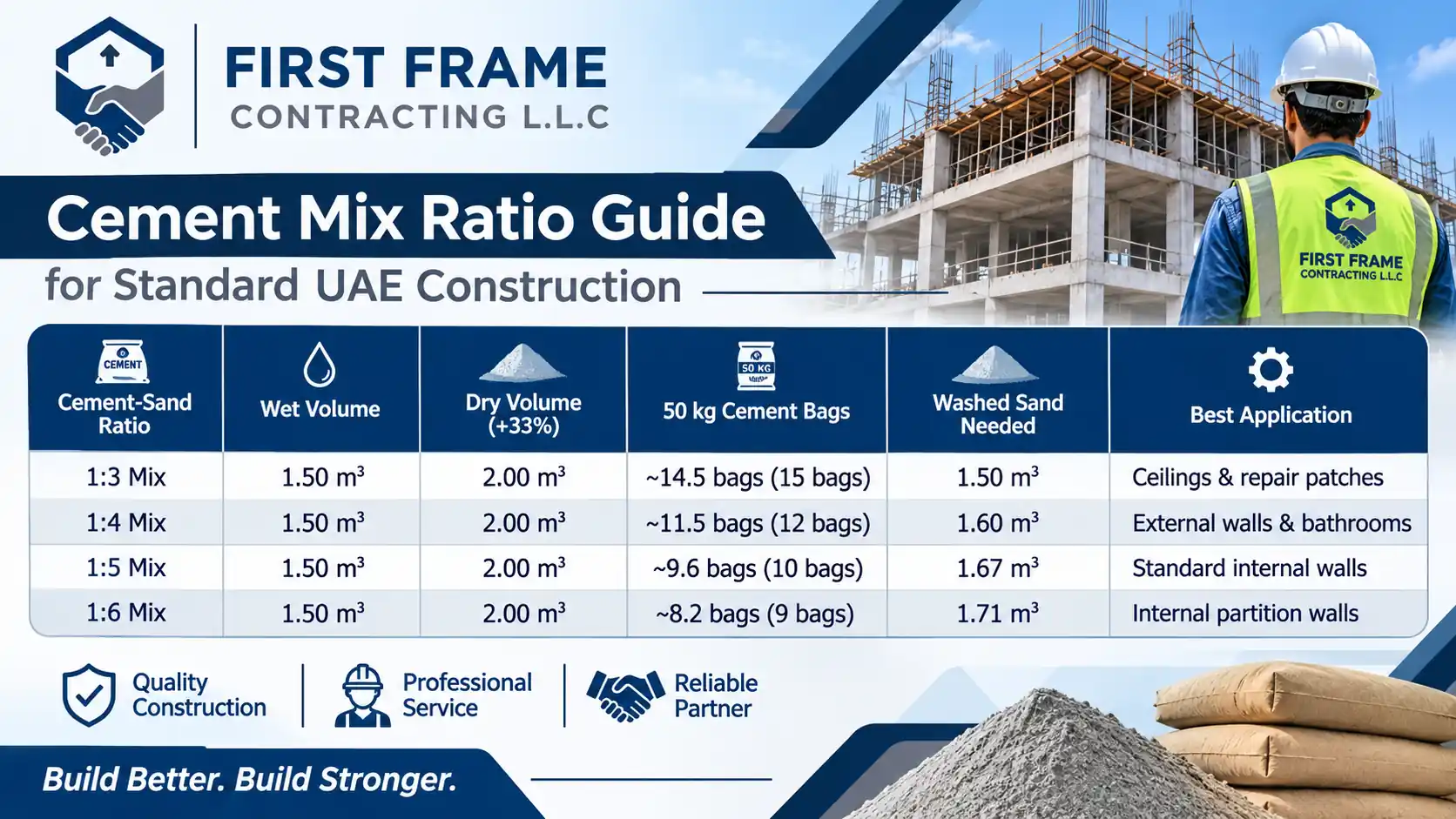
Note: Uneven blockwork or deep pipe chases usually require 10% to 15% extra mortar to level the wall.
Need Help Estimating Plaster Quantities or Planning Your Site? Send your wall dimensions or floor plan on WhatsApp (+971 544664100) or call 054 466 4100 to discuss your scope with an experienced Dubai contracting team.
How Professional Wall Plastering Works: 6 Stages from Preparation to Curing
Quality plastering follows a strict sequence of preparation, alignment, application, and curing. Skipping any step causes hollow walls and premature cracking.
Stage 1: Surface Cleaning and Concrete Hacking
First, workers brush away dust, loose mortar, and form oil from the blocks. Because smooth concrete columns do not grip plaster well, masons roughen (mechanically hack) the concrete or apply a bonding agent.
Stage 2: Installing Plaster Mesh and Corner Beads
Next, crews fix plaster mesh across all concrete-to-block joints and MEP chases. Simultaneously, they align plaster corner beads along external edges using spirit levels and laser lines.
Stage 3: Applying the Spatter Dash (Key Coat)
Before the main coat, masons spray a rough, wet cement slurry (1:3 mix) onto the wall. Once cured, this gritty texture locks the main plaster layer firmly in place.
Stage 4: Setting Plaster Dots and Screed Strips (Bullmarks)
To ensure a flat wall, masons place small mortar pads (dots) across the surface using laser levels. Afterward, they connect these pads with vertical mortar strips called screeds.
Stage 5: Main Coat Application and Leveling
Once the screeds firm up, crews fill the spaces between them with fresh mortar. Next, masons shave off excess mortar using a long aluminum straightedge and smooth the wall with a float.
Stage 6: Water Curing Cement Plaster for 7 Days
Finally, water curing gives cement plaster its true strength. Starting 24 hours after application, crews spray the walls with clean water several times daily for 7 days. Especially during Dubai’s hot summer (May to September), regular watering stops rapid drying and prevents shrinkage cracks.
[Image Placeholder 3: Worker spraying water onto freshly plastered cement walls for curing | Alt Text: cement wall plaster curing process in dubai construction]
Damp & Waterproofing Checks Before Plastering in Dubai
Applying fresh plaster over damp walls is one of the fastest ways to waste money. Therefore, reliable plastering companies in Dubai inspect moisture levels before starting work.
- Fix Plumbing Leaks First:Check concealed kitchen and bathroom pipes under pressure before closing wall chases.
- Apply Wet-Area Waterproofing:In bathrooms, balconies, and ground-floor walls near garden planters, apply a cementitious waterproofing coat before plastering.
- Check Roof and Window Seals:Make sure roof parapets and window frames are sealed so rainwater cannot seep behind interior plaster.
Essential Tools Used by Professional Plastering Crews
Checking a contractor’s tools reveals how seriously they take accuracy and site safety. Specifically, professional crews bring these tools to every site:
- Laser Levels and Plumb Bobs:Used to set accurate plaster thickness dots so walls stay vertical from floor to ceiling.
- Aluminum H-Rules (Straightedges):2-meter and 3-meter straightedges used to shave mortar flat across large wall spans.
- Wooden and Sponge Floats:Used to compact the surface and create an even texture ready for putty and paint.
- Certified Scaffolding Platforms:Aluminum or steel tower scaffolds required for safe access on high villa walls and warehouses.
Hand Plastering vs. Machine Spray Plastering in Dubai
Many plastering companies in Dubai now use plaster spray machines alongside traditional hand plastering. Comparing both methods helps you see which fits your project best:
- Hand Plastering:Ideal for villas, apartment renovations, bathrooms, and repair jobs. Skilled masons maintain precise control in tight rooms and around detailed corners.
- Machine Spray Plastering:Best suited for large warehouses, towers, and multi-villa projects. Spray machines pump pre-mixed mortar onto walls up to three times faster than hand application, ensuring uniform density.
However, even with a spray machine, skilled masons must still level walls manually with straightedges and finish corners by hand.
Plastering Rules in Dubai: Villas vs. High-Rise Towers (NOC & Fit-Out)
Plastering rules vary depending on whether your property is a private villa or a unit inside a managed tower. Understanding these local rules prevents work stoppages and building fines:
- High-Rise Towers (Marina, JLT, Business Bay, Downtown):Building management requires a Fit-Out NOC, third-party insurance, service lift bookings, and strict noisy-work hours before crews can hack concrete or mix mortar.
- Gated Villa Communities (Arabian Ranches, Dubai Hills, Jumeirah):Community developers require NOCs for external boundary wall rendering, structural extensions, and skip placement outside the plot.
- Industrial & Commercial Zones (Al Quoz, Dubai Industrial City):Authorities such as Dubai Municipality (DM), Trakhees, or DDA enforce strict fire-rating, scaffolding, and worker safety rules on warehouse and office fit-outs.
How to Choose the Best Plastering Company in Dubai: 6 Key Checks
Selecting the right contractor protects your property and avoids costly rework. Rather than picking a lump-sum estimate automatically, evaluate plastering companies in Dubai using six clear checks.
1. Verify UAE Trade Licensing and Authority Rules
First, confirm the company holds an active Dubai DET or free-zone trade license for building contracting or plastering. Additionally, check that the team understands NOC rules from building management, Dubai Municipality (DM), Trakhees, or DDA.
2. Inspect Workmanship on Current Sites
Never judge a contractor by photos alone. Instead, visit an active site to inspect their corner alignment, wall flatness, and daily site housekeeping.
3. Confirm Material Specs in Writing
Make sure your quotation clearly lists washed, salt-free sand and fresh Ordinary Portland Cement. Furthermore, confirm that plaster mesh and plaster corner beads are included in the written scope.
4. Check Scaffolding and Site Safety
For double-height villa ceilings, stairwells, or exterior facades, verify that crews use certified scaffolding rather than unsafe makeshift ladders.
5. Compare Itemized Plastering Quotations Side by Side
Ask every contractor to quote against the exact same written scope. Specifically, compare square-meter rates, plaster thickness, material supply, cleanup, and curing—just as you would when vetting general builders across the UAE.
6. Agree on Handover Quality Checks (Straightedge & Tapping Tests)
Before releasing final payment, inspect every finished wall using two simple industry tests:
- The 2-Meter Straightedge Test:Hold a 2-meter aluminum straightedge flat against the wall in several directions. Under standard UAE tolerances, any gap under the straightedge should stay within ±3 mm.
- The Tapping (Hollow Sound) Test:Lightly tap across the cured wall with a wooden handle or coin. A solid, dull thud confirms good bonding, whereas a hollow echo means debonded plaster that requires repair.
5 Common Plastering Mistakes That Cost Property Owners Money
Even small shortcuts during plastering create expensive problems after painting. Therefore, watch out for these five common mistakes on site:
- Omitting Mesh Over Pipe and Wire Chases:Wall grooves cut for electrical conduits and pipes almost always crack if plastered without fiberglass or steel mesh.
- Applying Thick Coats in One Pass:Mortar thicker than 20 mm applied in one layer sags and cracks as it shrinks. Always build up thick areas in two coats.
- Skipping Concrete Hacking:Plaster applied directly over smooth concrete columns often detaches within a year due to weak bonding.
- Rushing Water Curing:Letting fresh cement plaster dry out in summer heat stops hydration, leaving a weak, powdery surface.
- Painting Over Damp Walls:Applying paint before plaster dries traps moisture inside, causing paint bubbles and peeling within weeks.
Planning a Blockwork or Plastering Project in Dubai?
Whether you are renovating a villa, modifying office partitions, or finishing a commercial warehouse, proper wall preparation saves money over time. If you need technical guidance or site execution for masonry and cement plastering, you can learn more about our Dubai contracting team based in Dubai Industrial City.
You can also explore our full construction and contracting services to see how civil and finishing scopes work together. If you have floor plans or wall measurements ready, contact First Frame Contracting, call +971 544664100, or message us on WhatsApp for an itemized project assessment.
FAQs About Plastering Companies in Dubai
How do plastering companies in Dubai calculate project quotes?
Contractors calculate quotes using total wall and ceiling area (in square meters) plus linear meters of corner beads and mesh. Additionally, plaster thickness, scaffolding needs, and material supply affect the final estimate.
What is the ideal thickness for internal wall plaster?
Standard internal cement plaster on blockwork is 12 mm to 15 mm thick, while ceilings need 10 mm to 12 mm. Conversely, exterior walls exposed to sun and rain usually require 15 mm to 20 mm in two coats.
How long should new cement plaster cure before painting?
Cement plaster needs 7 days of daily water curing to build full strength. Afterward, walls should dry naturally for 14 to 28 days before applying primer and paint.
Should I use PVC or galvanized steel plaster corner beads?
Use galvanized steel corner beads for dry indoor walls needing high impact strength. However, choose heavy-duty PVC corner beads for bathrooms, kitchens, and exterior facades where humidity can rust metal.
Can gypsum plaster be used in bathrooms or exterior walls?
No. Gypsum absorbs water and softens whenever it gets damp. Therefore, always use cement-based building plaster in bathrooms, kitchens, balconies, and exterior facades.
What causes white powdery stains on newly plastered walls?
Those white deposits are called efflorescence (white salt stains). They appear when soluble salts from unwashed sand or damp blocks rise to the surface as the wall dries. Using washed sand and proper waterproofing prevents this problem.
Can one contractor handle both blockwork and plastering?
Yes. Hiring one contractor for both blockwork and plastering keeps walls plumb from the start and avoids trade delays. Moreover, it keeps a single team accountable for the finished surface.