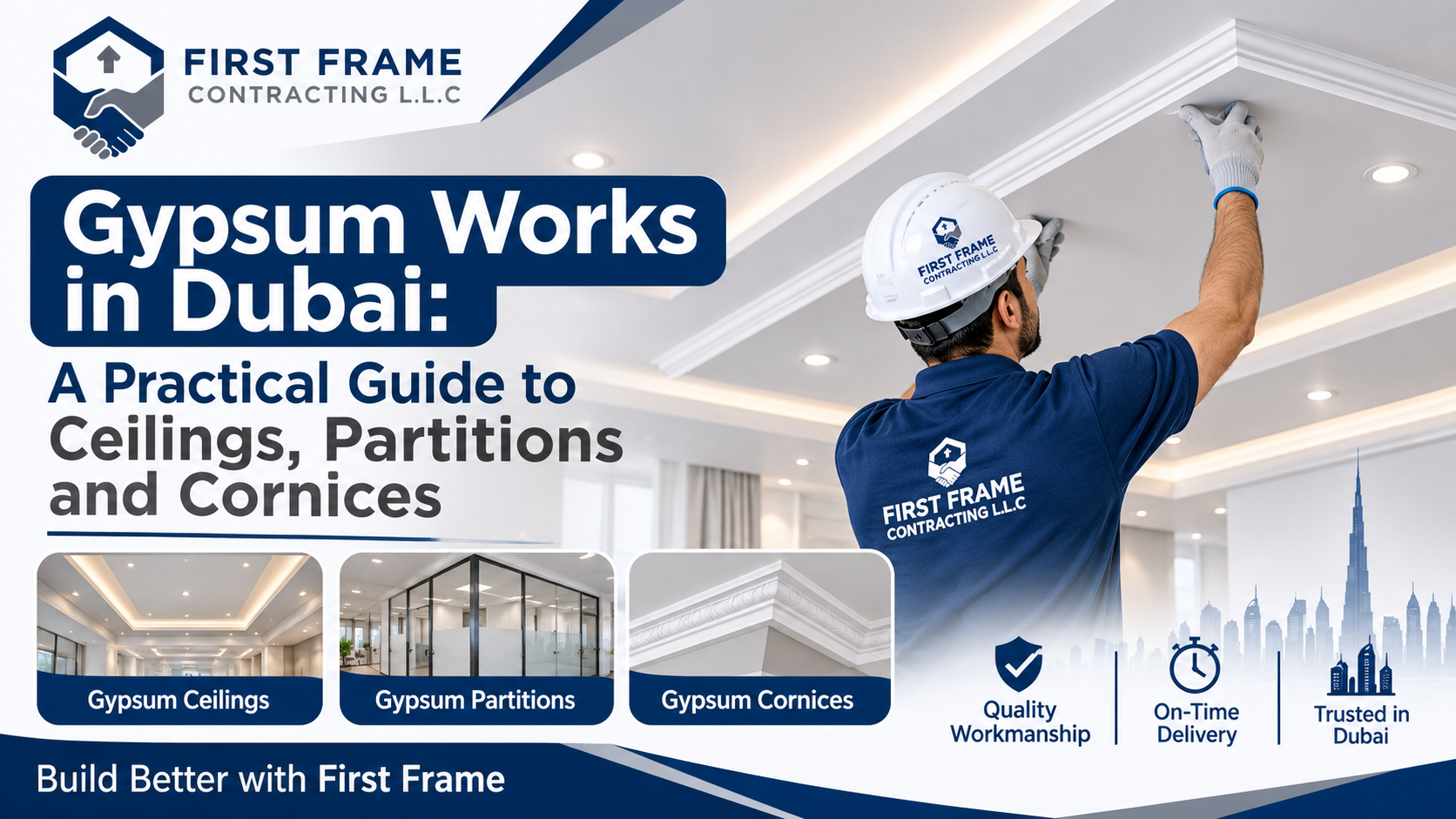
Walk into almost any modern villa, office or retail unit in the UAE and look up. The flat ceiling, the hidden lighting, the clean partition wall and the crisp line where wall meets ceiling are very often gypsum works. Done well, they are invisible. Done badly, they show up as cracks, sagging boards and patchy paint within a year.
This guide explains what gypsum works include, how they are installed, which materials matter, how the cornice fits in, and what to check before you hire a contractor in Dubai or Abu Dhabi. It is written for homeowners, landlords, facility managers and project teams who want clear answers before they commit to a scope.
Quick answer: gypsum works are interior jobs that use gypsum board or plaster to build false ceilings, partitions, bulkheads and cornices. In the UAE they are popular because they install quickly, hide AC and cabling, and give a smooth, paint-ready finish. Quality depends on four things: the right board for each room, a properly framed grid, services coordinated before the boards close, and careful jointing.
What Are Gypsum Works?
Gypsum works are interior building tasks that use gypsum, a soft mineral, in board or plaster form. In UAE fit-out and renovation, the term usually covers:
- Gypsum board (drywall) false ceilings
- Partition walls built on metal framing
- Bulkheads and drops that hide ducts, pipes or wiring
- Cove and cornice details for lighting and decoration
- Jointing, finishing and preparation for paint
Two terms are often mixed up:
| Gypsum board | Gypsum plaster | |
| Form | Pre-made panels fixed to a frame | Wet mix applied to a wall surface |
| Typical use | Ceilings, partitions, bulkheads | Smooth wall finishing |
| Speed | Faster, dry construction | Needs curing and drying time |
Gypsum board is the main material behind most false ceilings and partitions you see in the UAE. Manufacturers such as Knauf produce gypsum board regionally, including a plant in Ras Al Khaimah, so materials are generally available locally.
What Is a Gypsum Wall? Is plasterboard the same as gypsum board?
A gypsum wall is a non-load-bearing wall made of gypsum boards fixed to a metal or timber frame, then jointed and painted. It is the same thing people call a drywall or gypsum partition.
Plasterboard and gypsum board are essentially the same product: a gypsum core between two paper liners. “Plasterboard” is the more common term in UK-influenced usage, “drywall” in the US, and “gypsum board” is widely used in the UAE. Real differences come from the board type (standard, moisture-resistant, fire-rated) and the brand, not the name.
What is gypsum used for? Gypsum is a naturally occurring mineral. In building it goes into boards, plaster and moulded items such as cornice, which is why “gypsum works” covers both flat ceilings and decorative details.
What Is Plaster Work in Construction?
Plaster work in construction means applying a coating, traditionally cement- or gypsum-based, over blockwork or concrete to create a smooth, even surface for paint or tiles. It is a different trade from gypsum board work, although the two often meet on the same project: plaster on block walls, gypsum board on ceilings and partitions.
If you are renovating a villa, plaster repairs, block work and painting are usually planned together with ceiling works so the finishes match and trades do not damage each other’s work. Our villa renovation guide shows how these tasks are sequenced.
Common Types of Gypsum Works
False ceilings
A false ceiling hangs below the structural slab on a metal grid. It hides AC ducts, cabling and pipes and gives you a clean surface for downlights, cove lighting and diffusers. In Dubai villas, false ceilings also help organise AC returns and speaker or sensor wiring.
Gypsum partitions
Partitions divide space without the weight or time of block walls. They suit offices, shops, clinics and villa layout changes. Cavities can hold cables and sound insulation, and openings for doors and glazing are framed in the metal system.
Bulkheads, drops and cove lighting
Bulkheads conceal beams, ducts and service routes. Drops and steps in the ceiling create zones in open-plan areas. Cove lighting uses a recess so light washes along the ceiling, which needs careful measuring so the light source is hidden.
Decorative gypsum features
Feature ceilings, wall niches, TV walls and cornice lines are common in villas and hospitality interiors. Detail quality depends heavily on the finishing stage.
These tasks sit naturally inside interior fit-out projects, where ceilings, lighting, flooring and joinery have to line up.
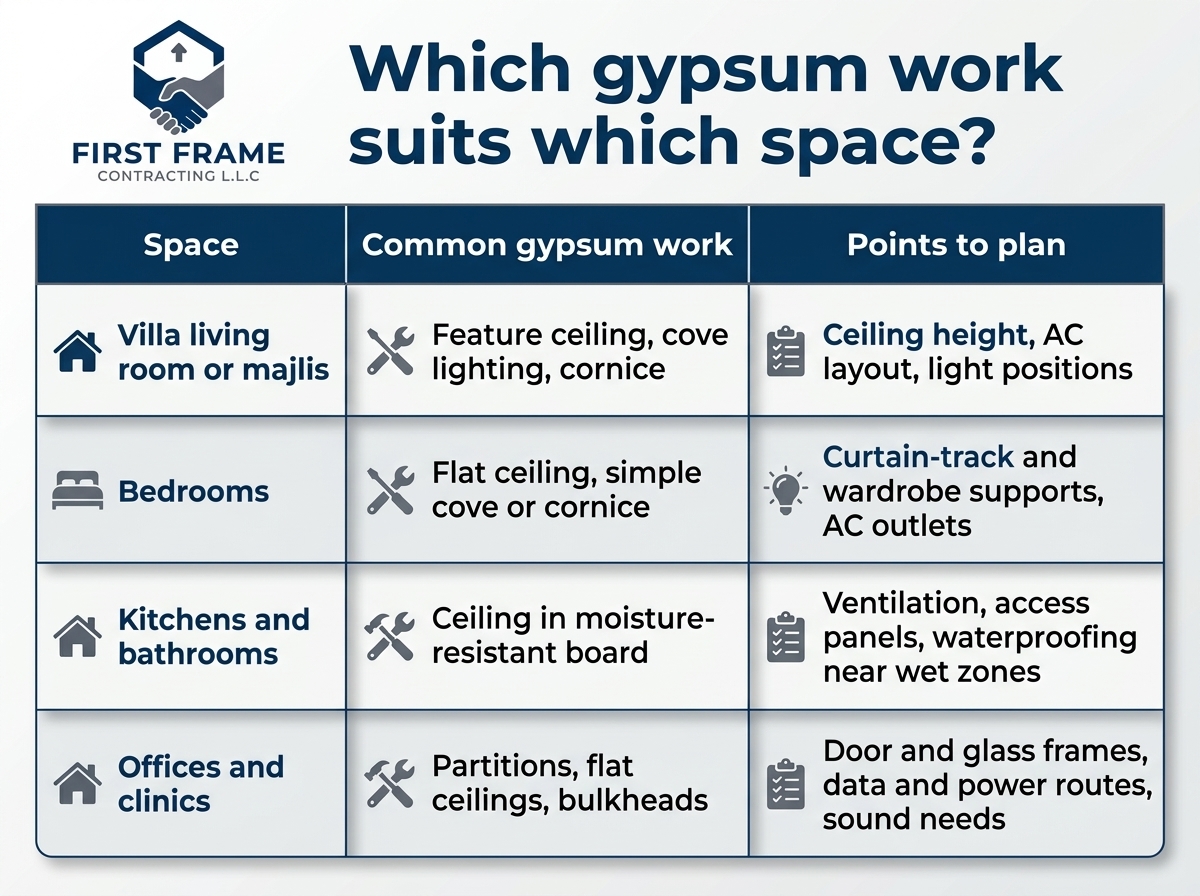
Which gypsum work suits which space?
Gypsum Partition or Block Wall: Which Should You Choose?
Both have a place. The right choice depends on what the wall has to do.
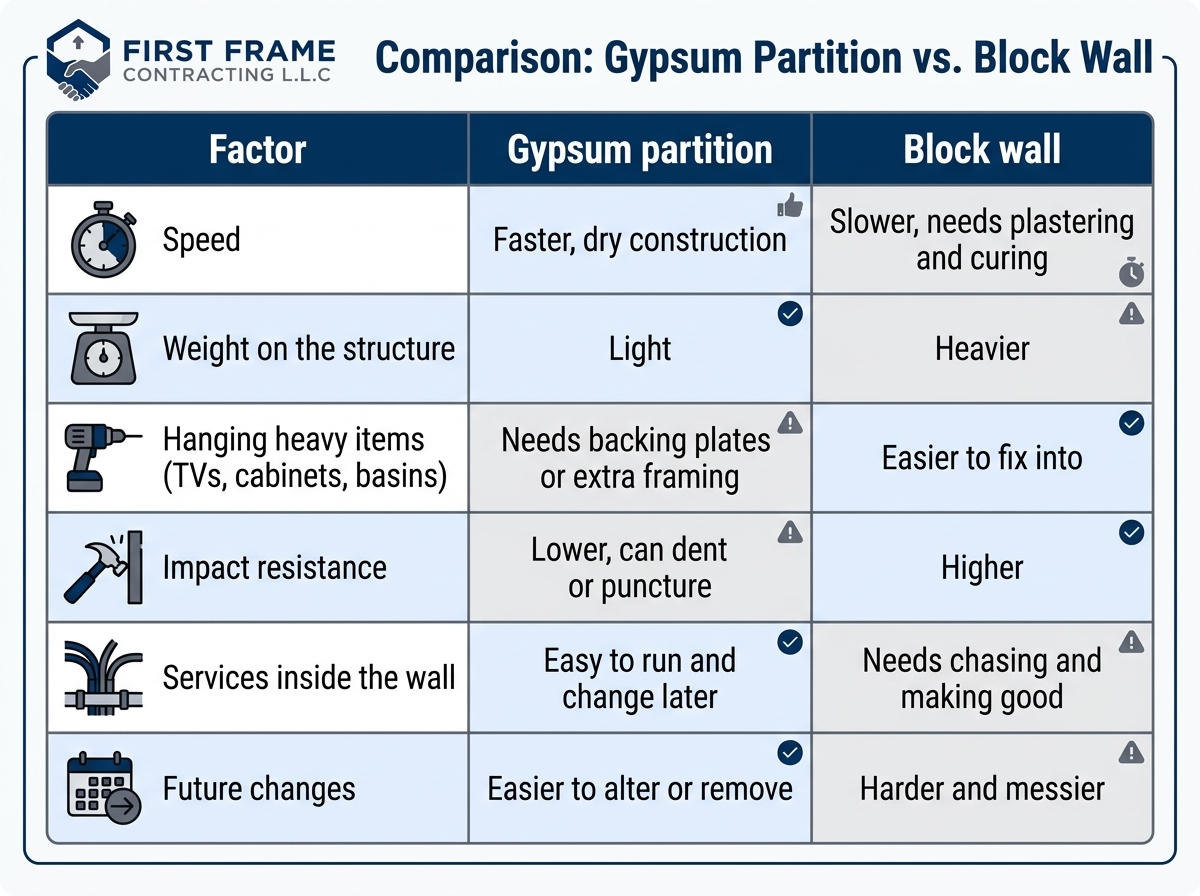
Many projects use both: block for external or structural walls and gypsum for internal dividing walls. Ask your contractor to mark where extra support is needed behind heavy items before the boards are closed.
Gypsum Cornice: Styles, Uses and Price Factors
What is a gypsum cornice?
A gypsum cornice is a moulding fixed or formed where the wall meets the ceiling. It hides the junction line, adds a finished edge and can carry decorative detail or hidden lighting. A cornice can be precast and fixed in length or built on-site from gypsum board and finished in place.
Plain versus decorative cornice
- Plain or cove profiles: simple, modern lines that suit apartments, offices and minimalist villas.
- Stepped profiles: a layered edge, often used to create a light recess.
- Decorative or classical profiles: carved patterns and deeper relief for traditional or luxury interiors. These may use cast gypsum or glass-reinforced gypsum.
When people search for ‘cornice Dubai’, they are often comparing these styles against their villa’s room size and ceiling height. Heavy, deep profiles can overwhelm a low ceiling, while very thin profiles can look lost in a large majlis.
Gypsum cornice price: what actually drives the cost?
Because cornice designs and site conditions vary widely across Dubai villas and commercial units, fixed price lists are rarely accurate. Instead, contractors calculate quotes based on these key factors:
- Profile complexity: plain profiles cost less than deeply carved ones.
- Size: height and projection affect material and fixing effort.
- Supply versus site-built: pre-cast pieces and custom-moulded ones are priced differently.
- Corners and joints: internal and external corners add labour and finishing.
- Ceiling height and access: high ceilings need scaffolding or platforms.
- Finishing and paint: jointing, sanding and paint are often priced separately.
- Lighting integration: a cornice with hidden lighting needs extra framing and coordination.
Ask every supplier or contractor to quote per linear metre, with corners, installation and finishing listed separately. Otherwise, quotes cannot be compared fairly.
Gypsum cornice supplier in Dubai: what to ask
When comparing suppliers, ask for sample profiles, the board or casting material used, the lead time for custom designs, and whether installation is included. If you are already planning ceiling works, ask whether the same team can handle both so measurements and finishes stay consistent. If you want First Frame to handle the cornice as part of a ceiling or fit-out scope, share your drawings or photos, and we will confirm what is included in the quote.
How Gypsum Works Are Installed Step by Step
Here is how plaster work in progress looks on a typical gypsum ceiling or partition job:
- Site survey and drawings: measure the room, confirm ceiling heights and mark AC, lighting and fire-safety items.
- Coordination: align with electrical, AC and plumbing teams so services are installed before boards close the space.
- Marking and framing: fix perimeter tracks and hang the metal grid or build partition studs.
- First-fix services: complete cabling and pipe runs, and install access points where maintenance will be needed.
- Board fixing: screwing boards to the frame, staggering joints.
- Jointing and finishing: tape joints, apply compound in coats, sand and prepare the surface.
- Cornice, cove and details: install or form edge details.
- Painting and final checks: prime and paint, then check levels, joints and light positions.
Timing depends on room size, design complexity and drying time between coats. A simple flat ceiling is much quicker than a multi-level ceiling with cove lighting, so ask for a schedule based on your drawings rather than a general estimate.
How to Calculate a Gypsum Board Partition
Here is a simple, illustrative example for a partition 5 m long and 3 m high, with one layer of board on each side. Always check it against your drawings and the manufacturer’s system.
- Board area per side: 5 × 3 = 15 m². Both sides: 30 m².
- Board size: a common board is 1.2 m × 2.4 m = 2.88 m². 30 ÷ 2.88 = 10.4, so 11 boards.
- Waste: add roughly 5 to 10 per cent for cuts, so about 12 boards.
- Studs: at 600 mm spacing, 5 ÷ 0.6 = 8.3. Round up and add one, so about 10 studs, plus extra framing around doors.
- Track: top and bottom, 2 × 5 m = 10 m.
- Accessories: screws, joint tape, joint compound, corner beads and insulation if needed.
Board sizes, stud spacing (often 400 or 600 mm), number of layers and framing depth change with wall height and performance needs. Door openings reduce board area but add framing, so final quantities should come from a site survey.
How to Fix a Gypsum Ceiling or Gypsum Board
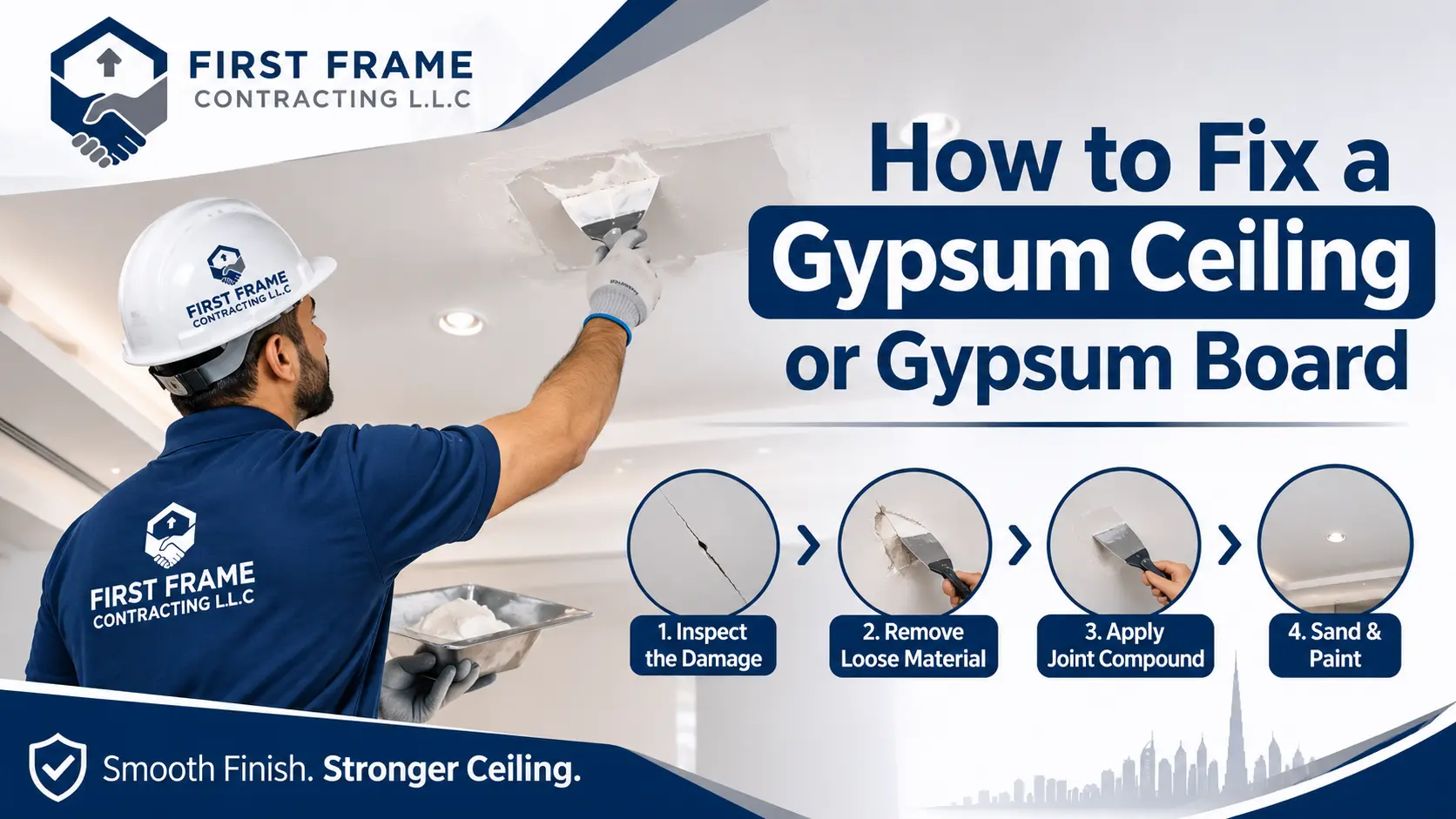
Find the cause first. A repair that ignores the cause will fail again.
- Small holes and dents: fill with joint compound or filler, sand, prime and repaint.
- Hairline cracks along joints: scrape loose material, re-tape if needed, apply compound in thin coats, sand and repaint. If the crack returns, look for weak fixing or framing movement.
- Larger holes: cut a clean square, fix a backing piece, screw in a new board piece, then tape, joint, sand and paint.
- Sagging ceiling:do not just repaint. Sagging usually means loose screws, wide hanger spacing, extra weight or moisture, and it needs inspection.
- Water stains:fix the leak first. You may need to replace damp boards and properly treat any mould.
Before cutting, remember that ceilings often hide wiring and pipes. Wear a dust mask and eye protection. Cosmetic patches are simple, but sagging, repeated cracks or water damage are better handled by a contractor.
Choosing the Right Gypsum Board
Not every board suits every room. Board types commonly available include:
- Standard boardsfor dry interior areas such as bedrooms and offices.
- Moisture-resistant boardsfor kitchens, bathrooms and humid zones.
- Fire-rated boardswhere fire resistance is required by the building or authority.
Board thickness, framing spacing and fixings should follow the manufacturer’s system specifications. Ask your contractor which board they plan to use in each room and why. Where fire rating applies to your building, confirm requirements with the building owner or relevant authority before work begins.
Is Gypsum Board Fire Resistant?
Gypsum board is fire resistant, but not fireproof. The gypsum core holds chemically bound water that turns to steam when heated, which slows the heat passing through the board. That is why gypsum is widely used in fire-rated walls and ceilings. The paper facing can still burn and the board eventually breaks down.
The actual rating, in minutes, depends on the tested system: board type, thickness, number of layers, framing, insulation and joint detailing. Standard board is not automatically fire-rated. If your building needs rated walls or ceilings, ask for the manufacturer’s tested system and confirm the requirements with your building owner or the relevant authority.
Can You Put Tile on Gypsum Board?
Yes, in dry areas with proper preparation, but wet areas need a different approach.
- Dry walls:the board must be flat, firmly fixed and fully jointed. Use a tile adhesive suited to the surface and follow the adhesive maker’s primer advice.
- Showers and wet areas:do not tile directly onto standard board. Use moisture-resistant or cement-based backer board with a proper waterproofing system, following the manufacturer’s instructions.
- Heavy finishes:marble, stone and large-format tiles are heavy. Ask your contractor to confirm framing spacing and board layers before fixing.
Planning the board and the tiling together avoids cracked tiles and failed joints. See our guide to floor and wall tiling works.
Gypsum Works in Dubai and Abu Dhabi: Local Considerations
The UAE climate and building types shape how gypsum works should be planned.
- Air conditioning:most ceiling layouts need to work around ducts, diffusers and returns. Poor planning can cause condensation or uneven cooling.
- Humidity:coastal humidity and wet areas call for appropriate board types and good ventilation.
- Villas and apartments:many communities require landlord, owner association or developer approval for ceiling or partition changes. Check your community’s rules before starting. Specific permit requirements vary by project and authority, so confirm them with your building management or the relevant authority rather than assuming.
- Commercial units:fit-out guidelines from the landlord or mall management often apply, including fire and safety requirements.
- Abu Dhabi projects:the approvals process and community rules can differ from Dubai, so confirm requirements for your specific location at the start.
For ongoing upkeep of ceilings and walls in a villa, see our villa maintenance guide.
Gypsum Works Subcontractors: What to Check Before Hiring
Developers, fit-out companies and project managers often need gypsum works subcontractors for part of a larger package. Whether you are a homeowner or a main contractor, check:
- Scope clarity:boards, framing, jointing, cornice, painting and cleaning, listed separately.
- Drawing and coordination ability:can they work from your drawings and coordinate with MEP trades?
- Material specification:brand, board type and thickness named in the quote.
- Supervision:who manages the crew on site, and how are snags handled?
- Programme:realistic schedule and what could delay it.
- Payment terms:staged payments tied to progress, not large upfront payments.
- Valid trade licence and insurance:ask for documents and verify them yourself.
A contractor who manages ceilings alongside blockwork, plastering, painting, flooring, and electrical coordination often reduces delays because the project requires fewer handovers.. You can see the range on our services page.
Common Problems and How to Avoid Them
- Cracks along joints:often caused by poor jointing, weak framing or building movement. Insist on proper tape and multiple finishing coats.
- Sagging ceilings:usually from too wide hanger spacing or heavy fixtures without extra support. Heavy lights need dedicated support.
- Water stains or mould:from leaks or condensation. Fix the source first and use suitable boards in wet areas.
- No access to services:if valves or AC components are hidden, repairs mean breaking the ceiling. Plan access panels at the start.
- Patchy paint:commonly a finishing issue. Ask for primer and enough coats.
- Misaligned cove or cornice lines:caused by poor measuring. Request a mock-up or sample for key areas.
Care and Maintenance After Installation
A few habits keep gypsum ceilings and walls looking new for longer:
- Fix leaks quickly.Water is the main enemy of gypsum board, so deal with AC drain issues and plumbing leaks early.
- Do not hang heavy items from ceiling boards.Chandeliers, speakers and fans need their own support fixed to the slab or structure.
- Keep a record.Take photos of the ceiling and wall framing before the boards are closed, so you know where pipes, cables and supports run.
- Know your access panels.Keep them clear and use them for AC and valve servicing instead of cutting new holes.
- Inspect once or twice a year.Look for hairline cracks, stains, sagging and loose joints, and repair small problems before they spread.
Frequently Asked Questions
What are gypsum works?
Gypsum works are interior construction tasks using gypsum board or plaster, such as false ceilings, partitions, bulkheads, cornices and the jointing and finishing that prepare them for paint.
What is plaster work in construction?
Plaster work is the application of a smooth coating over walls or ceilings, usually cement- or gypsum-based, to prepare them for paint or tiles. It differs from gypsum board work, which uses pre-made panels on a metal frame.
What does plaster work in progress involve?
On a gypsum job it typically means surveying, framing, coordinating services, fixing boards, jointing, sanding, adding cornice or cove details and painting. Each stage needs drying time, so quality work cannot be rushed.
Who provides gypsum works in Dubai and Abu Dhabi?
Interior fit-out contractors, renovation companies and specialist subcontractors provide gypsum works across the UAE. Compare written scopes, board specifications, supervision and valid licences, not just price. First Frame Contracting is based in Dubai Industrial City and can discuss your project.
What should I look for in gypsum works subcontractors?
A clear scope, named materials, a realistic programme, MEP coordination experience, staged payments and verified licensing and insurance.
How much does a gypsum cornice cost?
It depends on profile complexity, size, corners, ceiling height, supply method, finishing and any hidden lighting. Ask for a quote per linear metre with corners, installation and finishing itemised. Prices quoted for other countries are not a useful guide for UAE projects.
Where can I find a gypsum cornice supplier in Dubai?
Start by asking for sample profiles, material type, lead time and whether installation is included. If you also need ceiling works, ask whether one team can handle both so measurements and finishes match.
Do gypsum works in Malta, Gozo or East Leake apply to the UAE?
No. Building codes and approval rules in Malta, Gozo, the UK and other countries differ from the UAE, so use a contractor based where your project is located. First Frame Contracting works in Dubai and the wider UAE.
Is gypsum board fire resistant?
Yes, it is fire resistant but not fireproof. The gypsum core releases bound water as steam when heated, which slows heat transfer. The rating depends on the tested system, not the board alone, so ask for the manufacturer’s rated system where fire resistance is required.
Can you put tile on gypsum board?
Yes in dry areas, with a flat, well-fixed, fully jointed board and a suitable adhesive. In showers and other wet areas, use moisture-resistant or cement-based backer board with waterproofing instead of standard board.
Is plasterboard the same as gypsum board?
Essentially yes. Both are a gypsum core between paper liners. The names vary by region, and the real differences are board type (standard, moisture-resistant, fire-rated) and brand.
How do you fix a gypsum ceiling or gypsum board?
Find the cause, then fill and re-joint small holes and cracks, patch larger holes with a backing piece and new board, and sand, prime and repaint. Sagging or water-damaged ceilings need inspection by a contractor.
How do you calculate a gypsum board partition?
Multiply length by height, double it for two sides, divide by the board area (for example 2.88 m² for a 1.2 × 2.4 m board), round up and add about 5 to 10 percent for waste. Then count studs, track and accessories from the spacing in your system.
How does a plaster cutter work?
On a gypsum job, a plasterboard cutter is usually a sharp scoring knife. You score through the paper face along a straight edge, snap the board along the line, then cut the back paper to release it. For openings such as sockets and downlight holes, installers use a hand saw or a rotary cutter. Always cut on a stable surface and wear a dust mask and eye protection.
How does belladonna plaster work?
Belladonna plaster is a medicinal product, not a building material, so it has nothing to do with gypsum plaster or construction. For questions about it, speak to a doctor or pharmacist.
Does gypsum cause cancer?
Finished gypsum board on walls and ceilings is a standard interior material. The main concern on site is dust from cutting, sanding or demolition, which can irritate eyes, nose and throat. Check the manufacturer’s safety data sheet, wear a mask and eye protection, ventilate the area and clean dust with a damp cloth or vacuum.
Conclusion
Good gypsum works are about planning as much as installation: the right board for each room, a frame designed for the loads, space for AC and lighting, and careful finishing. If you want a cornice or cove detail, define the profile, corners and lighting early so you can compare quotes properly.
Whether you are upgrading a villa, fitting out a shop or managing a larger project, clear drawings, a written scope and a contractor who coordinates the trades will protect both your budget and your finish quality.
Get in Touch
Planning a false ceiling, partition or cornice detail? Send First Frame Contracting your room dimensions, photos or drawings and tell us whether you need ceilings only or a wider interior scope. We will talk through board choices, finishing and how the work fits with your other trades.
Ready to talk about your project? Contact First Frame Contracting for a conversation about your plans.
- Company:First Frame Contracting L.L.C.
- Location:Saih Shuaib 4, Dubai Industrial City, UAE
- Phone:+971 544664100
- WhatsApp:Chat on WhatsApp
- Email:info@firstframecontracting.com
- Business Hours:8:00 AM – 10:00 PM
- Contact Page:Contact First Frame Contracting